


Beijing aims to annex Taiwan and reshape the international order, National Security Council Secretary-General Joseph Wu (吳釗燮) and Jamestown Foundation president Peter Mattis told an international forum in Taipei yesterday.
The premise for US-Chinese interaction and co-commitment to peace dissolved with the end of the Cold War and both sides are now locked in an institutional struggle, Mattis said at the International Conference on US-China Strategic Competition in 2025: Implications for China and Cross-Strait Relations organized by the Mainland Affairs Council.
Both sides are fighting skirmishes on a global scale, he said in his segment, titled “The Illusion of Stability in the Taiwan Strait.”
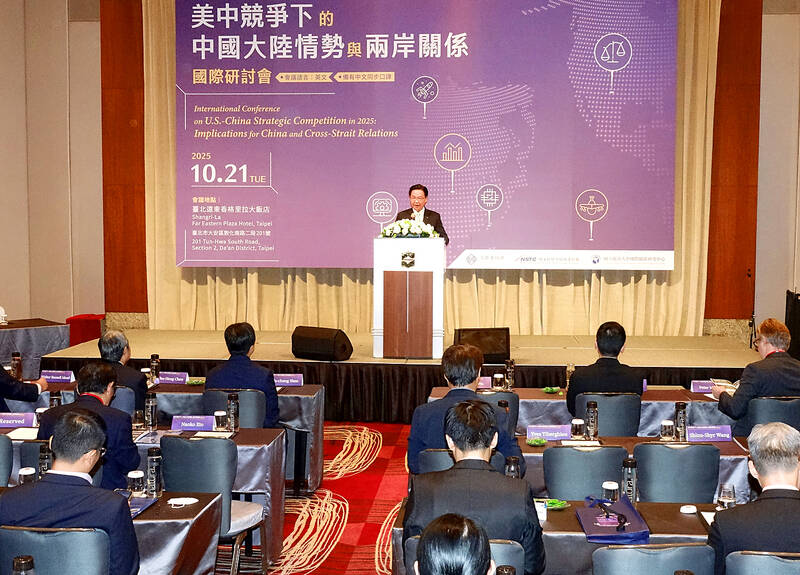
Photo: Tien Yu-hua, Taipei Times
Taiwanese have the right to self-determination regardless of how Taiwan’s status is viewed by the international community, but the Chinese Communist Party (CCP) is trying to deprive them of that right, as it does not even recognize that Chinese have the right to choose their own future, Mattis said.
Taiwan was too slow to increase its national defense spending and had been inefficient in using the funds, he said, adding that Taiwan poorly understood the Chinese People’s Liberation Army (PLA).
Young Taiwanese are uninterested in the CCP, “but the CCP is very interested in you,” he said.
Taiwan should be looking into defense collaborations with the US, and should consider similar collaborations with the EU, Mattis said.
Where Taiwan is short on funds, it could make up for it with intelligence about China, as both sides speak Mandarin, he said.
Wu said that Taiwan is not the only target in Beijing’s sights, and Chinese threats to Taiwan are direct threats to global peace.
The PLA’s influence has already spread beyond the first island chain, he said, citing a PLA exercise near Australia this year as an example.
States within the first island chain are facing the possibility of war because of the PLA, Wu said.
Taiwan plans to increase its defense spending from 3 percent of GDP this year to 5 percent by 2030, and has updated its Han Kuang exercises to show the public that the military can protect them in times of war, he said.
China is more interested in expansionism than solving its own pressing economic and social issues, he said.
“Even though we see worrisome trends in the Chinese economy, the news these days is not how the PRC [People’s Republic of China] leadership [is] coming up with good or big packages to bring their economy up from the slump, it’s about the purge of top PLA generals,” he said.
Last week, ahead of its plenum, China announced that two top military leaders had been expelled from the party and the military on corruption charges, the most senior officers to be purged in an anti-graft drive that began in 2023.
Wu also mentioned the scenes from last month’s military parade in Beijing held by Chinese President Xi Jinping (習近平) to mark the 80th anniversary of the end of World War II.
“The footage of the Sept. 3 military parade gave an impression of China still seeking global dominance, not solving domestic economic and social problems. This doesn’t make too much sense to me,” he said.
Hudson Institute researcher Walter Russell Mead said that the US belief that a strong economy would foster democracy had evidently not been the case with China.
The US must find other methods, as its previous policy has not been successful, Mead said.
In addition, under US President Donald Trump, the US is no longer taking the lead in resolving global conflicts, he said.
Compared with NATO, Trump evidently prefers allies such as Israel, as it is willing to commit to national defense, he said, adding that Trump would like to see a change in its relationship with nations such as Japan, which uses the US’ Aegis Combat System, but still maintains close economic ties with China.
Although meaningful talks on the Taiwan issue are unlikely with China, Trump would not relent on matters of US interests, while Xi must uphold the propaganda currently spread in China, Mead said.
Additional reporting by Reuters

The National Chungshan Institute of Science and Technology yesterday showcased its locally developed variants of the Vision 60 robotic patrol dog, which it plans to deploy on the nation’s outlying territories in the South China Sea. The variants were produced under the Joint Lab project — created by the institute and domestic companies — and assembled with domestically produced motors, lenses and artificial intelligence (AI) systems alongside licensed tech from the US, Missile and Rocket Systems Research Division deputy director Jen Kuo-kang (任國光) told the media event at a military base in Taipei’s Dazhi (大直) area. Taiwan has built up its strengths

RIGHT DIRECTION: Taiwan’s efforts to prevent forced labor include a proposal to ‘fully prohibit’ employers from withholding workers’ documents, an official said Taiwan is to establish a mechanism to restrict imports of goods linked to forced labor, the Executive Yuan said yesterday, after the US proposed imposing additional tariffs on Taiwanese goods over labor concerns. “The Ministry of Labor and the Ministry of Economic Affairs are to establish an interministerial review procedure,” Executive Yuan spokesperson Michelle Lee (李慧芝) said at a news briefing in Taipei. “The government is to use the Foreign Trade Act [貿易法] as the legal basis to restrict imports of goods produced with forced labor” and bring its supply chain governance more in line with international standards on human rights, resilience

NOT IMMEDIATE: Taiwan has a chance to appeal the proposed 10 percent tariff before it starts, while other countries face a 12.5 percent tariff from the trade office Taiwan is among 60 economies determined by the US to have failed to impose or enforce a ban on the importation of goods produced with forced labor, according to a notice released on Tuesday by the Office of the US Trade Representative (USTR), which proposed imposing an additional 10 percent or more tariff on them. The USTR in a statement said that following an investigation, it had determined under Section 301 of the Trade Act of 1974 that the failure of the 60 economies to impose and effectively enforce a prohibition on the importation of goods produced with forced labor is

TIT-FOR-TAT: The US allegedly revoked the visa of a Chinese national working at Xinhua News Agency in the US in response to Beijing’s expulsion of Vivian Wang The Presidential Office yesterday condemned China for expelling a New York Times correspondent from Beijing following the newspaper’s interview with President William Lai (賴清德), saying the move highlighted Beijing’s suppression of press freedom and its threat to international news media. Taiwan has noted a series of recent incidents in which Beijing used similar tactics to “threaten and pressure international media outlets and journalists,” Presidential Office spokeswoman Karen Kuo (郭雅慧) said in a statement. “This concerns not only press freedom and freedom of expression, but also the safety of journalists, and Taiwan and relevant partners are paying close attention to the situation,” she


 RSS
RSS